
The Compass Broke, I Kept Walking
A Story of Collapse, Clarity, and the Courage to Continue
It is the story of a boy from a Brooklyn tenement who was drafted at eighteen, refused to carry a gun, and was sent to Vietnam anyway — and of the long walk back from that.
The compass broke early: war, trauma, silence, rebuilding, and the slow return to clarity. This book is the foundation of everything that came after — the lived experience behind the later work on fear, culture, citizenship, and human behavior.
Paperback · $14.99 Hardcover · $24.99 Kindle · $4.99
Also available at: Barnes & Noble, Bookshop.org.
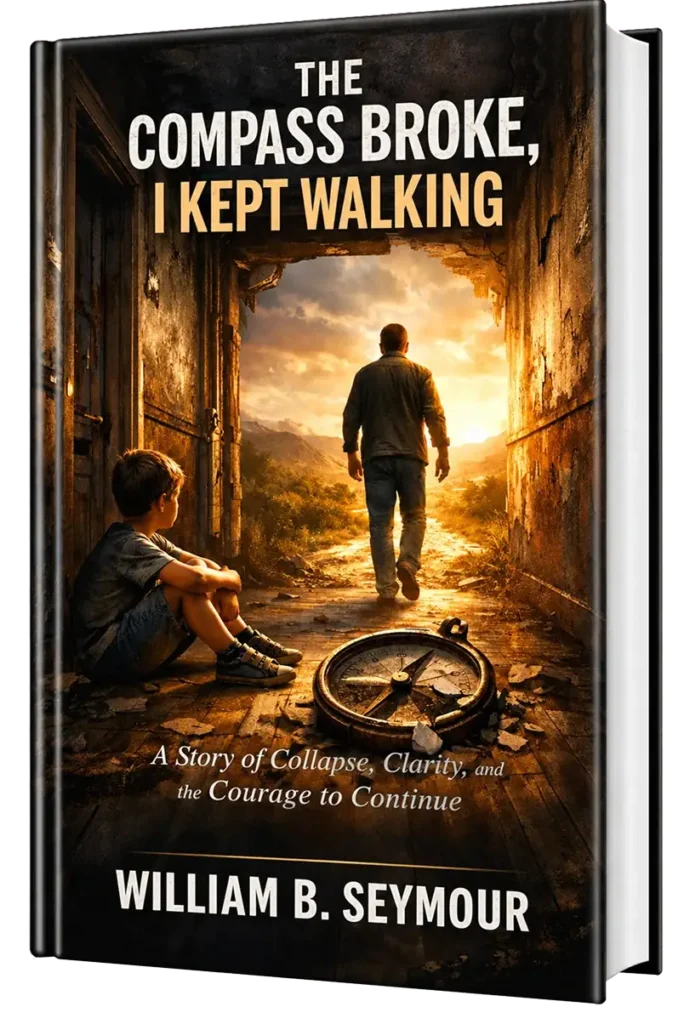
A Story of Collapse, Clarity, and the Courage to Continue
This is not about hiking, trails, or finding your way through the wilderness. It is about what happens when the direction you trusted disappears, the life you expected changes, and you are left to find your own way forward.
William B. Seymour looks back across more than seven decades of experience, beginning with a difficult childhood in Brooklyn and continuing through military service, Vietnam, business, relationships, family, personal loss, and the unexpected turns that shaped the man he became. His life was never guided by a perfect plan. Much of what mattered most was learned through circumstances he could neither predict nor control.
The book offers a different perspective on military service. Seymour entered the Vietnam era as a conscientious objector, determined to remain faithful to his personal convictions while still answering his obligation to serve. Vietnam confronted him with fear, responsibility, moral conflict, and the realities of making decisions under pressure. Those experiences remained with him long after his uniform was gone.
But this is not simply a war memoir. It is a book about an entire life.
Seymour writes about building businesses, loving people, losing people, making mistakes, starting again, and discovering that some beliefs we carry when we are young do not survive experience. He does not present himself as someone with all the answers. Instead, he looks back from the perspective of a man who has lived long enough to recognize what mattered, what did not, and what he might have done differently if he had known then what he knows now.
There is seriousness in these pages, but there is also humor, warmth, curiosity, and gratitude. Ordinary experiences become part of the larger story because Seymour understands that a life is rarely defined by one dramatic moment. It is built through thousands of choices, conversations, mistakes, relationships, victories, and quiet realizations.
The Compass Broke, I Kept Walking speaks to readers who have experienced change, disappointment, uncertainty, or the need to begin again. It does not promise a perfect map.
It simply shows what can happen when you keep walking.
